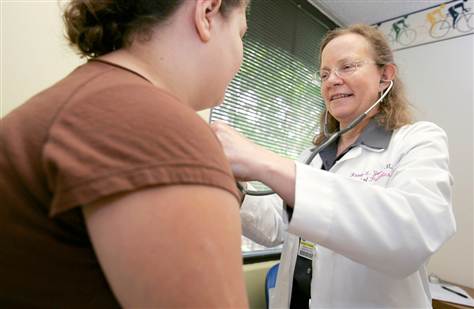
Researchers found that overweight people repeatedly placed in a stressful situation exhibited increasing amounts of interleukin-6, an inflmmatory marker, in their saliva.
This cytokine is secreted by T cells and macrophages to stimulate immune response, e.g. during infection and after trauma, especially burns or other tissue damage leading to inflammation. Additionally, interleukin-6 has been associated with a number of conditions for which obesity itself creates an increased risk, including atherosclerosis, type 2 diabetes, cancer and fatty liver disease.
The experiment consisted in placing subjects in stressful situations, including a very unfriendly job interview and a difficult oral math exercise. They then took saliva samples to see how the stress affected the release of inflammatory mediators.
Researchers observed that lean people started out with lower interleukin-6 levels than obese people, but all participants exhibited similar amounts of biochemical response to stress. However, when the stress situation were repeated the following day, obese people doubled the concentrations while lean people's response was similar to the previous day. Interestingly, on the second day, intrerleukin-6 concentrations in saliva correlated with body mass index.
Source: http://www.cbsnews.com/news/for-obese-stress-may-be-even-more-deadly/
Showing posts with label overweight. Show all posts
Monday, 29 September 2014
Stress is more deadly for obese people than for lean ones
Labels:
BMI,
cytokine,
inflammation,
overweight,
stress
Wednesday, 11 April 2012
Consciousness of self weight is important for weight loss
Do we have a real perpception of our weight? Do we know if we are really overweight or not? This is what researchers at the University of Illinois investigated when they surveyed over 3,500 college applicants, as part of the Up Amigos project, a collaboration with the Mexican Universidad Autónoma de San Luis Potosi. More than a third couldn't report their weight accurately, and overweight and obese men were more likely to underestimate their weight than women.
In contrast to what one would thought, almost half of the male volunteers underestimated their weight. Females were more realistic, as 21.2% believed that they were overweight when 27.8% of women were actually overweight or obese. This is even more worrying in the adolescence. According to figures released by the Centers for Disease Control and the International Journal of Pediatric Obesity, American teens are even less likely to report their weights correctly.
Very few participants in the Mexican study overestimated their weight, but those who did were most often female, younger, had parents with less education, and watched more television. Ideal body image changes with exposure to Western media, the researchers noted. The curvier female figure once appreciated in Latino culture is being replaced by the ultra-thin ideal promoted by Western advertisers.
Monday, 12 December 2011
Doctors need to be honest with their patients and say ‘Your kid’s overweight’
According to a study published online in Archives of Pediatrics & Adolescent Medicine, doctor should tell parents when their children are overweight as this would improve their motivation to follow healthy eating and activity.
Perrin and co-authors Asheley Cockrell Skinner, and Michael J. Steiner, performed a secondary statistical analysis of data collected from 4,985 children ages 2 to 15 years old who had a body mass index (BMI) at or above the 85th percentile based on measured height and weight. The data were collected as part of the National Health and Nutrition Examination Survey (NHANES) from 1999 to 2008.
During that time, only 22 percent of parents reported that a doctor or other health professional told them their child was overweight. This percentage increased from 19.4 percent in 1999 to 23.4 percent in 2004, and then to 29.1 percent in 2007-2008. Even among parents of very obese children, only 58 percent recall a doctor telling them.
Perrin and co-authors Asheley Cockrell Skinner, and Michael J. Steiner, performed a secondary statistical analysis of data collected from 4,985 children ages 2 to 15 years old who had a body mass index (BMI) at or above the 85th percentile based on measured height and weight. The data were collected as part of the National Health and Nutrition Examination Survey (NHANES) from 1999 to 2008.
During that time, only 22 percent of parents reported that a doctor or other health professional told them their child was overweight. This percentage increased from 19.4 percent in 1999 to 23.4 percent in 2004, and then to 29.1 percent in 2007-2008. Even among parents of very obese children, only 58 percent recall a doctor telling them.
However, as shown in the journal Pediatrics parents are reluctant to be told that their children have an unhealthy weight.
Labels:
BMI,
childhood obesity,
doctors,
overweight,
parents
Subscribe to:
Posts (Atom)